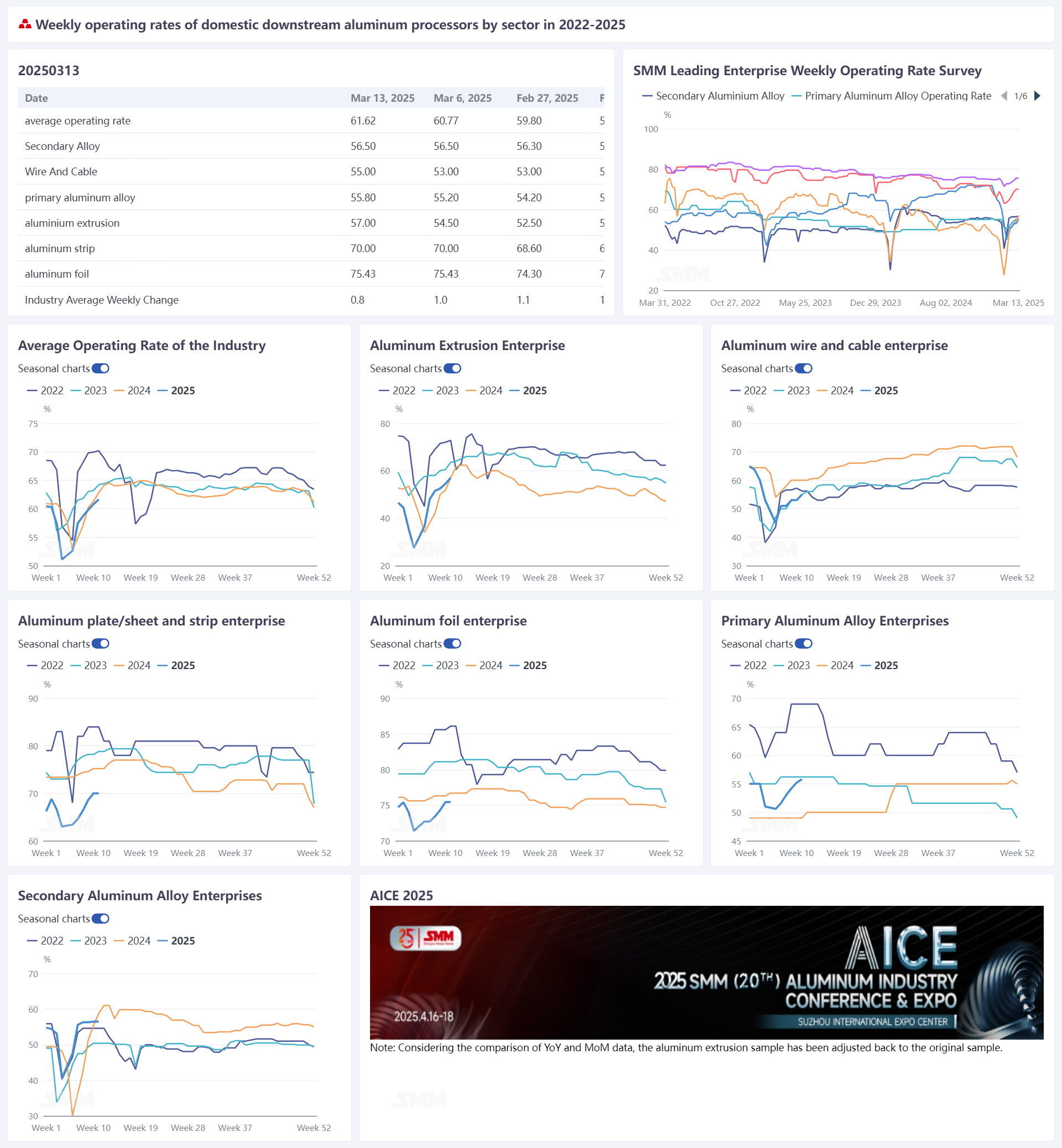
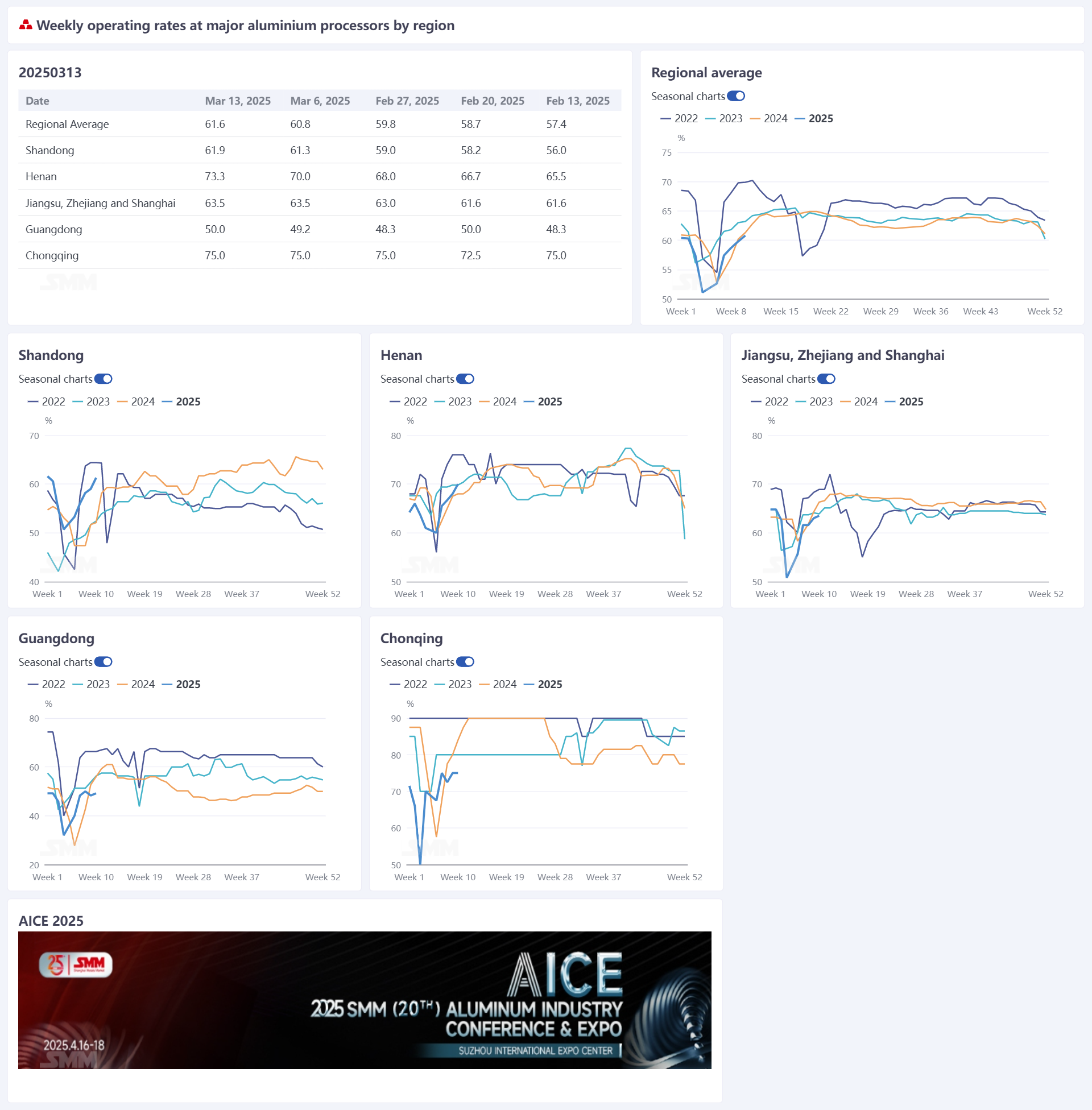
This week, the operating rate of leading domestic downstream aluminum processing enterprises maintained an upward trend, rising 0.8 percentage points WoW to 61.6%. By segment, the operating rate of primary aluminum alloy producers increased slightly by 0.6 percentage points WoW to 55.8%. High aluminum prices suppressed downstream restocking demand, and future production momentum may be constrained by demand alignment. The operating rates of aluminum plate/sheet and strip and aluminum foil remained stable. In the aluminum plate/sheet and strip sector, weakening export data combined with divergent domestic consumption expectations weighed on enterprise confidence. Aluminum foil demand remained steady, with potential growth in overseas orders serving as a future support point. Aluminum wire and cable benefited from the concentrated release of power grid orders, with the operating rate up 2 percentage points WoW to 55%, and shipments in April are expected to further boost production. During the week, the operating rate of aluminum extrusion rose 2.5 percentage points WoW to 57%, supported by demand for industrial extrusion from PV rush for installations, NEVs, and high-voltage power transmission grid orders, while the construction materials segment achieved differentiated growth through green transformation. The operating rate of secondary aluminum alloy producers faced pressure in its rebound, as weak demand and rising aluminum prices squeezed corporate profits, posing a risk of rate adjustments. Overall, aluminum processing enterprises continued their recovery trend, but consumption recovery fell slightly short of expectations. High aluminum prices suppressed downstream purchase willingness, limiting the operating rates of some enterprises during the week, resulting in a modest overall increase. SMM predicts that the operating rate will continue its upward trend next week, potentially surpassing the 62% threshold.
From the Perspective of Different Sections:
Primary Aluminum Alloy: This week, the operating rate of leading domestic primary aluminum alloy enterprises recorded 55.8%, up 0.6% WoW. Aluminum prices surged to near the 21,000 yuan mark this week, and the overall operating rate of primary aluminum alloy enterprises continued a steady recovery trend, though the increase was below expectations. The reasons include, on one hand, weak demand after aluminum prices hit a short-term high, with downstream restocking willingness remaining low, causing the operating rates of some leading primary aluminum alloy enterprises to stabilize or slightly decline WoW. On the other hand, although some enterprises entered the normal liquid aluminum cycle for the month, their operating performance remained in an upward phase. However, as it has been over a month since the Chinese New Year holiday, the inertia of production expansion on the supply side has gradually diminished. Moving into mid-to-late March, the operating rate of downstream primary aluminum alloy enterprises is expected to continue a mild recovery trend. However, if subsequent demand fails to match the supply side, the momentum for further production expansion in the industry will be insufficient. SMM expects the operating rate of primary aluminum alloy enterprises to maintain a slow upward trend next week, but attention should be paid to the partial suppression of downstream demand by high aluminum prices.
Aluminum Plate/Sheet and Strip: This week, the operating rate of leading aluminum plate/sheet and strip enterprises remained stable at 70%. The incremental orders brought by seasonal market recovery fell short of expectations, and most aluminum plate/sheet and strip enterprises operated steadily during the week, with no significant changes in operating rates. Recently, the conclusion of the Two Sessions in China has raised expectations for improved consumption in sectors such as automotive and home appliances. However, concerns about a "weak peak season and sluggish consumption" have been widespread. Coupled with the release of February export data showing a MoM decline in exports, the confidence of aluminum plate/sheet and strip producers has been further dampened. The operating rate of leading aluminum plate/sheet and strip enterprises is expected to remain stable or slightly increase in the short term.
Aluminum Wire and Cable: This week, the operating rate of leading domestic aluminum wire and cable enterprises was 55%, up 2% WoW, remaining in a recovery phase. Recently, the power grid has concentrated on tendering, with formal tenders for State Grid distribution network materials, North China agreement inventory, and East China overhead line agreement inventory, as well as the official announcement of South Grid material tenders. The expected increase in orders is gradually being realized. As mid-March approaches, enterprises report that power grid orders will begin to be delivered from April. Additionally, new orders have been received recently, and enterprises are rushing to meet deadlines for some planned orders during the off-season, driving a rebound in operating rates. The operating rate is expected to gradually transition to a mild upward trend.
Aluminum Extrusion: This week, the operating rate of the domestic aluminum extrusion industry increased by 2.5 percentage points WoW to 57%. Operating rates across various extrusion sectors showed divergent characteristics. In the industrial extrusion segment, the NEV industry chain maintained high momentum, with leading enterprises' orders remaining saturated, and some small and medium-sized enterprises scheduling new orders in an orderly manner. In the PV sector, the surge in distributed rush-for-installation orders and the concentrated delivery of centralized projects formed a dual engine, with leading enterprises reporting significant order growth for March-April, operating at near full capacity. The market exhibited a resonance between domestic distributed rush-for-installation demand and overseas restocking demand, boosting component enterprises' capacity utilization rates and actual order intake, thereby driving related extrusion demand. In the construction materials segment, a differentiated trend was observed. While engineering orders were in the final stages, some enterprises opened new markets through product structure upgrades—integrated solutions for whole-house customization drove the release of demand for formaldehyde-free home decoration, with orders for mid-to-high-end aluminum alloy doors and windows showing growth. The penetration rate of green product certification systems in the industry continued to rise, fostering a positive trend of transitioning traditional construction materials toward green intelligent manufacturing. SMM will continue to monitor industry dynamics, focusing on the inventory cycle turning point during the "Golden March and Silver April," the pace of end-use demand recovery, and marginal changes in regional industrial policies.
Aluminum Foil: This week, the operating rate of leading aluminum foil enterprises remained unchanged at 75.4%. The aluminum foil market remained relatively stable, with no significant changes in demand for packaging foil, battery foil, or air-conditioner foil. Although rising aluminum prices continued to dampen downstream customers' enthusiasm for picking up goods, they did not have much direct impact on the production of leading aluminum foil enterprises. Some aluminum foil enterprises reported a significant increase in overseas orders compared to pre-Chinese New Year levels in March, which may provide more support for the operating rate of the aluminum foil industry. The operating rate of leading aluminum foil enterprises is expected to remain stable or slightly increase in the future.
Secondary Aluminum Alloy: This week, the operating rate of leading secondary aluminum enterprises remained flat WoW at 56.5%. Consumption recovery continued to fall short of expectations, with die-casting enterprises experiencing weak order growth. Meanwhile, the rising center of aluminum prices during the week led to cautious downstream procurement sentiment, resulting in limited actual transactions and suppressing the upward movement of operating rates. Additionally, insufficient orders have increased the circulation of market supplies, intensifying price competition due to supply surplus and further compressing enterprise profit margins. If demand remains weak in the future, the industry's operating rate may face downward pressure.